
The Green Pool Revolution: How Luxury Hotels Are Rethinking Sustainability
From solar heating to natural filtration, the world's best hotels are proving that eco-conscious pools can be just as luxurious as traditional ones.
The Green Pool Revolution: How Luxury Hotels Are Rethinking Sustainability
A swimming pool is, by design, an environmental paradox. Thousands of gallons of treated water, heated to comfortable temperatures, surrounded by energy-intensive pumps and filtration systems—all so we can float in blissful relaxation. It's not exactly a low-carbon activity.
But something is shifting in the luxury hospitality industry. The world's most forward-thinking hotels are proving that exceptional pool experiences and environmental responsibility aren't mutually exclusive. In fact, some are discovering that sustainable pools can be better pools.
Here's what's happening at the leading edge of eco-conscious aquatics.
The Water Challenge
Let's start with the elephant in the room: water.
A typical hotel pool holds between 20,000 and 100,000 gallons. In water-stressed regions—which increasingly includes luxury destinations from California to Cape Town to the Maldives—that's a significant resource commitment.
What leading properties are doing:
Rainwater Harvesting
The Six Senses portfolio has been pioneering rainwater collection systems that feed directly into pool systems. Their Fiji property captures enough monsoon rainfall to offset pool evaporation losses entirely during wet season.
Greywater Integration
Some properties are treating and recycling greywater from showers and sinks for pool deck irrigation and landscape maintenance, reducing overall property water consumption by 20-30%.
Evaporation Control
Pool covers aren't glamorous, but they're remarkably effective. Properties in arid climates like Aman's Utah resort use automated covers during off-hours, reducing evaporation by up to 95%. The energy savings from reduced heating demand are substantial too.
Smart Backwash Systems
Traditional pool filtration backwash wastes hundreds of gallons daily. New recirculating backwash systems can recover up to 90% of that water, sending it back through the filtration system rather than to the drain.
Energy Innovation
Heating and operating a pool is energy-intensive. A large resort pool can consume as much electricity as 50 homes. But the most progressive properties are finding ways to dramatically reduce that footprint.
Solar Thermal Heating
Solar pool heating isn't new, but it's reaching new levels of sophistication. Modern vacuum tube collectors can heat pool water even on cloudy days, and smart integration with property management systems optimizes performance.
The Brando in French Polynesia—Marlon Brando's vision for a sustainable luxury resort—uses seawater air conditioning combined with solar thermal heating to achieve carbon-neutral pool operations. The pool temperature stays perfect year-round without burning a single fossil fuel.
Heat Pump Technology
Air-source heat pumps have improved dramatically, now achieving coefficients of performance above 6.0—meaning they produce six units of heating for every unit of electricity consumed. Properties in temperate climates are finding heat pumps more economical than traditional gas heating.
Waste Heat Recovery
Some clever properties are capturing waste heat from their kitchens, data centers, and laundry operations to warm their pools. The Proximity Hotel in North Carolina was an early pioneer, using restaurant refrigeration exhaust to maintain pool temperature.
Variable Speed Pumps
Traditional pool pumps run at full speed constantly—massive energy waste. Variable speed pumps adjust output to actual need, reducing electricity consumption by 50-70% while maintaining water quality.
Natural Filtration: The Bio-Pool Movement
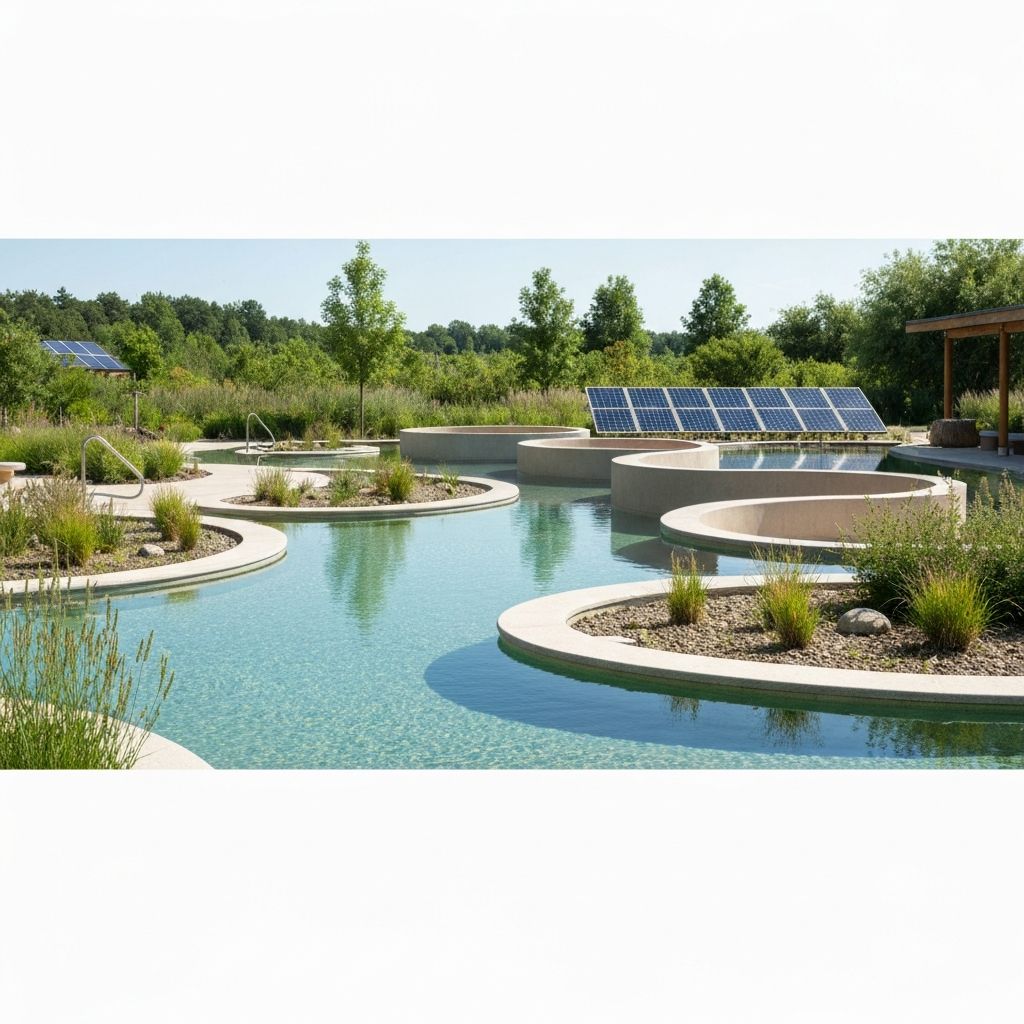
Perhaps the most exciting development in sustainable pools is the growing adoption of natural filtration—pools that use plants and biological processes instead of (or alongside) chemical treatment.
How Natural Pools Work
A natural swimming pool typically has two zones: a swimming area and a regeneration zone filled with aquatic plants. Water circulates between the zones, with plants and beneficial bacteria removing nutrients and pathogens naturally.
Advantages:
No chlorine or chemical treatment needed
Creates wildlife habitat
Often more beautiful than traditional pools
Lower operating costs long-term
Chemical-free swimming experience
Challenges:
Larger footprint required (regeneration zone adds 30-50% to size)
Seasonal plant management
Different water appearance (clear but may have slight green tint)
Guest education required
Not yet accepted by all health departments
Where Natural Pools Are Thriving
Europe leads in natural pool adoption, particularly in Austria, Germany, and Switzerland where public natural swimming ponds are common. Luxury properties like Stanglwirt in Austria feature stunning natural pools alongside traditional options.
Australia is seeing rapid growth, with several high-end properties embracing the "billabong" aesthetic—natural pools that blend seamlessly into the landscape.
North America lags due to stricter health regulations, but private estates and some boutique properties are finding ways to incorporate natural filtration principles.
Hybrid Approaches
Many properties are adopting hybrid systems: chemical treatment reduced to minimal levels, supplemented by UV sanitation, ozone injection, and natural elements. The result is water that feels more natural while meeting regulatory requirements.
Materials and Construction
Sustainability extends beyond operations to how pools are built.
Sustainable Concrete
Traditional pool construction relies heavily on concrete—one of the most carbon-intensive building materials. Forward-thinking builders are using:
Recycled aggregate
Supplementary cementitious materials (fly ash, slag)
Carbon-curing technologies
Reduced-cement mixes
Some pools are being built with alternative structures entirely: fiberglass shells, stainless steel containers, or modular systems that reduce material waste.
Responsible Sourcing
The stone, tile, and decking materials around luxury pools can carry significant environmental footprints. Properties committed to sustainability are asking questions about:
Quarry practices and restoration
Transportation distances
Fair labor practices
End-of-life recyclability
Local materials aren't just better for the environment—they often enhance the sense of place that makes a pool memorable.
Longevity as Sustainability
Perhaps the most sustainable pool is one that lasts. Investing in quality construction, proper engineering, and materials that age gracefully means fewer renovations, less waste, and lower lifetime environmental impact.
The Guest Experience Equation
Here's where it gets interesting: sustainable pools often provide better guest experiences.
Water Quality
Guests consistently rate saltwater and reduced-chemical pools higher than heavily chlorinated alternatives. Natural pools receive the highest satisfaction scores of all—though with smaller sample sizes.
Atmosphere
A pool surrounded by native landscaping and natural filtration plantings feels more connected to place than one ringed by concrete. The biodiversity attracted by natural pools—dragonflies, birds, butterflies—adds experiential richness.
Temperature Consistency
Solar-heated and heat-pump systems often provide more stable temperatures than gas heating, with fewer of the temperature swings that can detract from the swimming experience.
Story and Meaning
Increasingly, guests want to feel good about their choices. A property that can articulate its sustainability story—and demonstrate it in tangible ways—creates an emotional connection that enhances the overall experience.
What We're Watching
Based on our research and industry conversations, here are the sustainability trends we expect to shape hotel pools in coming years:
Regenerative Pools
Beyond "less bad," some properties are exploring pools that actively benefit their environments—creating habitat, managing stormwater, providing ecosystem services. The pool as environmental asset rather than liability.
Water-Positive Properties
A handful of properties are committing to return more water to local systems than they consume. Pools will need to be part of that equation, driving innovation in water recovery and recycling.
Carbon Accounting
As more hotel companies commit to science-based emissions targets, pools will face scrutiny. Expect to see carbon labeling for pool operations and pressure to demonstrate pathway to net-zero.
Guest Participation
Some properties are finding ways to involve guests in sustainability efforts—pool heating powered by gym equipment, conservation messaging, opt-in programs for reduced pool servicing in low-occupancy periods.
Certification Standards
We anticipate development of pool-specific sustainability certifications, giving properties a way to validate and communicate their environmental credentials.
Our Assessment Approach
At Pool Atlas, we're integrating sustainability into our evaluation framework. While we don't penalize traditional pools, we note:
Water sourcing and conservation measures
Energy systems and renewable integration
Chemical treatment approach
Construction materials and methods
Operational practices
Properties demonstrating leadership in sustainable pool operations will be recognized in our rankings and commentary.
The Bottom Line
The luxury pool industry is at an inflection point. Water scarcity, energy costs, and guest expectations are all pushing toward more sustainable approaches. Properties that get ahead of this curve will find themselves with lower operating costs, differentiated guest experiences, and stronger brand positioning.
The pools of 2030 will look different from the pools of today—not worse, but better. More thoughtfully integrated into their environments. More efficient in their operations. More attuned to the values of the guests who swim in them.
That's a future worth swimming toward.
Know of a property doing exceptional work in pool sustainability? We'd love to hear about it. The best innovations often come from unexpected places.
Get the best pools in your inbox
Monthly discoveries, new rankings, and destination guides — no noise.
Advertisement