

Behind the Design: How Infinity Pools Are Built
The science, engineering, and sleight of hand behind the world's most photogenic pools. It turns out 'vanishing' is harder than it looks.
Behind the Design: How Infinity Pools Are Built
An infinity pool looks like a miracle — water that simply ends, dissolving into the view beyond. The illusion is so complete that first-time swimmers often hesitate at the edge, uncertain of where solid ends and empty begins.
It's not magic. It's engineering. And the story of how these pools work is more fascinating than the Instagram photo suggests.
The Optical Illusion, Explained
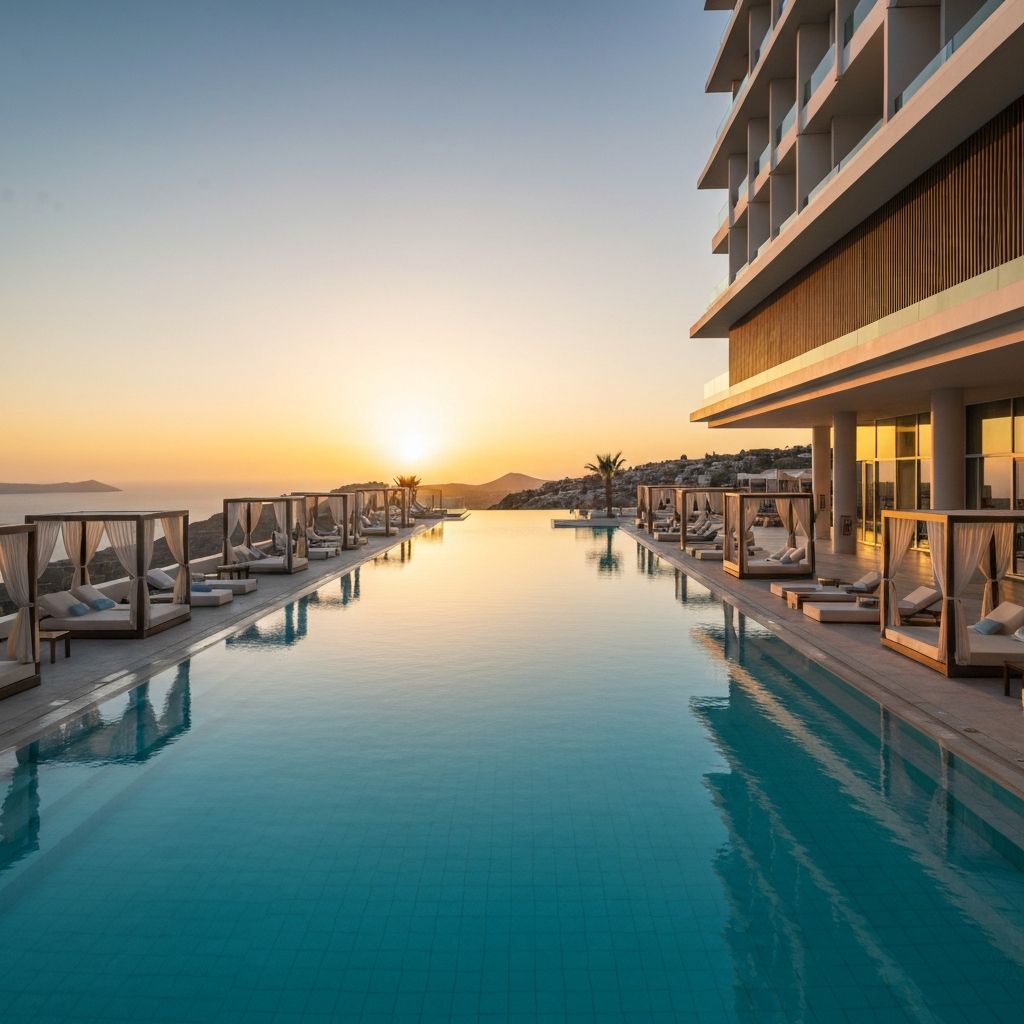
An infinity pool — also called a negative edge, vanishing edge, or zero-edge pool — creates the appearance of water extending to the horizon by hiding the far edge of the pool below the water's surface.
The pool is designed so that the water level sits precisely at or slightly above the top of the "vanishing wall." Water flows continuously over this wall into a catch basin (a hidden secondary pool or trough below), where it's pumped back into the main pool. The water flow is constant. The edge is always wet. And from the right angle — which the architect has carefully calculated — you see nothing but water meeting sky.
The entire effect depends on a single critical measurement: the height of the vanishing wall relative to the water surface. Too high, and the wall is visible. Too low, and the flow is uncontrolled. Designers typically aim for the water level to sit 3-5 millimeters above the wall's lip — a margin smaller than your pinky fingernail, maintained consistently across the entire length of the edge.
The Engineering Behind "Simple"
That constant, even flow sounds straightforward. It isn't.
Leveling
For the overflow to be even across the entire vanishing edge, the top of the wall must be perfectly level. Not close to level. Level within fractions of a millimeter across potentially dozens of meters of pool edge.
Any settling, subsidence, or construction imprecision shows up immediately as uneven flow — a trickle in one spot, a waterfall in another. High-end infinity pools are monitored continuously and edge heights are corrected periodically as the structure settles over time. Some premium installations include adjustable weir plates — thin stainless steel strips that can be fine-tuned after construction to maintain perfect levelness.
The Catch Basin
Every vanishing edge pool has a secondary body of water: the catch basin or balance tank that collects the overflow. This tank must be large enough to handle the pool's entire water volume when people get in (which raises the level and increases overflow) and when people get out (which drops it).
The catch basin is typically hidden directly below or adjacent to the vanishing edge, invisible from the main viewing angle. At Marina Bay Sands, with its 375-foot-long pool, the catch basin is substantial engineering in its own right.
Water is pumped from the catch basin back to the main pool continuously. The pumping system must be sized precisely — too slow and the main pool drops; too fast and it overflows onto the deck.
Wind
An often-overlooked challenge is wind. Wind creates surface ripples and pushes water toward or away from the vanishing edge unevenly. A strong crosswind on a long infinity edge will cause significantly more overflow on the windward side.
Pool designers study prevailing wind patterns at each site and often orient the vanishing edge perpendicular to the dominant wind direction. Wind breaks — walls, landscaping, architectural features — are frequently integrated into the design, though they must be positioned carefully to avoid disrupting the view that makes the pool worth building.
Thermal Expansion
Water volume changes with temperature. A pool that's perfectly balanced at 30°C will behave differently when it cools overnight. The catch basin must accommodate this variation without the system running dry or overflowing.
For heated pools in cold climates, thermal management adds another layer of complexity. The pool water, catch basin water, and equipment are all at different temperatures during heating and cooling cycles.
Location Changes Everything
The same pool design behaves differently depending on where it's built.
Clifftop pools — like Grace Santorini or the Ritz-Carlton Bali — are the classic infinity configuration. The catch basin is built into the cliff structure below the vanishing edge. Construction requires careful structural integration with the geology, and access for maintenance can be challenging.
Rooftop pools — like Marina Bay Sands or the 1 Hotel Brooklyn Bridge — add structural engineering requirements. The water weight is enormous (roughly 1,000 kilograms per cubic meter), and the building below must accommodate it. Waterproofing is critical — a rooftop pool leak can cause catastrophic damage to floors below.
Overwater pools — increasingly common in the Maldives and other tropical destinations — sit on platforms above lagoons. The structural engineering is marine-grade. Catch basins typically pump directly into filtration systems rather than into the ocean. Saltwater environments accelerate corrosion, so materials specifications are demanding.
What It Costs
Building an infinity pool is expensive. A residential infinity pool in a good climate runs $80,000–$200,000 for a reasonably sized installation. High-end hotel infinity pools — large format, complex geometry, premium materials — frequently run $1–5 million before landscaping.
The cost drivers are:
Precision construction: The tolerances required for a perfect vanishing edge mean specialized contractors and extended installation time
Materials: The vanishing wall and catch basin are often clad in high-end tile, dark-colored to make the water appear deeper and to disappear visually
Pumping equipment: Commercial-grade, redundant systems with carefully calculated flow rates
Ongoing maintenance: Edge adjustment, equipment servicing, and water chemistry management are more complex than standard pools
The Color of the Water
One design choice that significantly affects the infinity pool experience: tile color.
Dark tiles — deep blue, black, charcoal — make the water appear deeper and darker, creating a more dramatic vanishing effect. The water surface reflects the sky more purely because the pool bottom is not visible through it.
Light tiles — white, pale blue, turquoise — create clearer, more transparent water where you can see the bottom. The visual experience is more "Caribbean vacation" than "dramatic architectural infinity." Both are valid; they create different experiences.
The best designers choose tile color based on the specific view the pool is meant to frame. A pool overlooking a blue ocean might use dark tiles to deepen the color contrast. A pool surrounded by green jungle might use tiles that create turquoise water that stands apart from the foliage.
What Makes a Great Infinity Pool
After analyzing hundreds of pools across Pool Atlas, patterns emerge in what separates the memorable from the merely photogenic:
The best infinity pools have a clear sightline — nothing between the vanishing edge and the view it's meant to frame. Every architectural element, landscape decision, and detail of pool placement serves that view.
They're built with precise orientation. The sun path matters. The prime viewing time — sunset, sunrise, or full-day — is built into the pool's positioning, not an accident.
And they understand that the pool is a frame, not the subject. The greatest infinity pools are designed in service of something beyond themselves: a caldera, a mountain range, a cityscape, an ocean. The pool's job is to give you the best possible seat for that view.
When those elements align, you get the pools on Pool Atlas's world rankings. When they don't, you get an expensive feature in a hotel brochure that looks better in photographs than in person.
Discover the world's finest infinity pools on Pool Atlas → See the full rankings
Get the best pools in your inbox
Monthly discoveries, new rankings, and destination guides — no noise.
Advertisement